Example
−$5
A rival sells the same 26 cm skillet for $79.00. You charge $84.00.
Know what your competitors charge. Find what to sell next.
PriceSway finds your competitors from your product catalogue, checks their prices every day, and tells you when a rival undercuts you and where your prices stand. It also finds products you could add that can win against the stores already selling them, with a price to sell at. Every plan includes price recommendations for products with a unit cost and either a competitor price or enough sales history.
3-day free trial · we email you the day before it ends · works with any platform
- days free on every plan, cancel before the first charge
- 3
- days free on every plan, cancel before the first charge
- products checked daily on Starter, US$49/mo
- 250
- products checked daily on Starter, US$49/mo
- tracked competitors on Starter, any platform
- 100
- tracked competitors on Starter, any platform
- product research runs a month on Starter
- 4
- product research runs a month on Starter
No competitor hunting on your part.
Your catalogue does the work.
- 01
Tell us where you sell
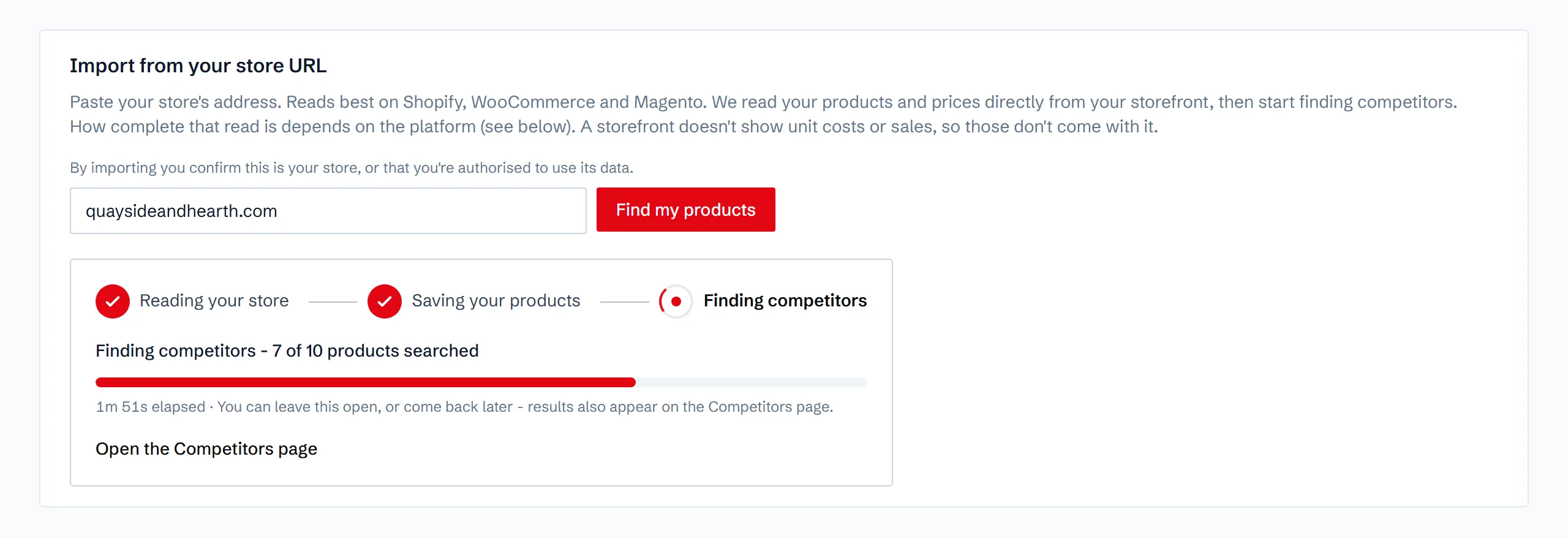
Sign up, paste your store's address - any platform works - and start your 3-day trial. Your products come in on their own and become the search input, so there is nothing else to configure. No store yet? Tell us what you'd like to sell and start with product research.
- 02
We find your competitors
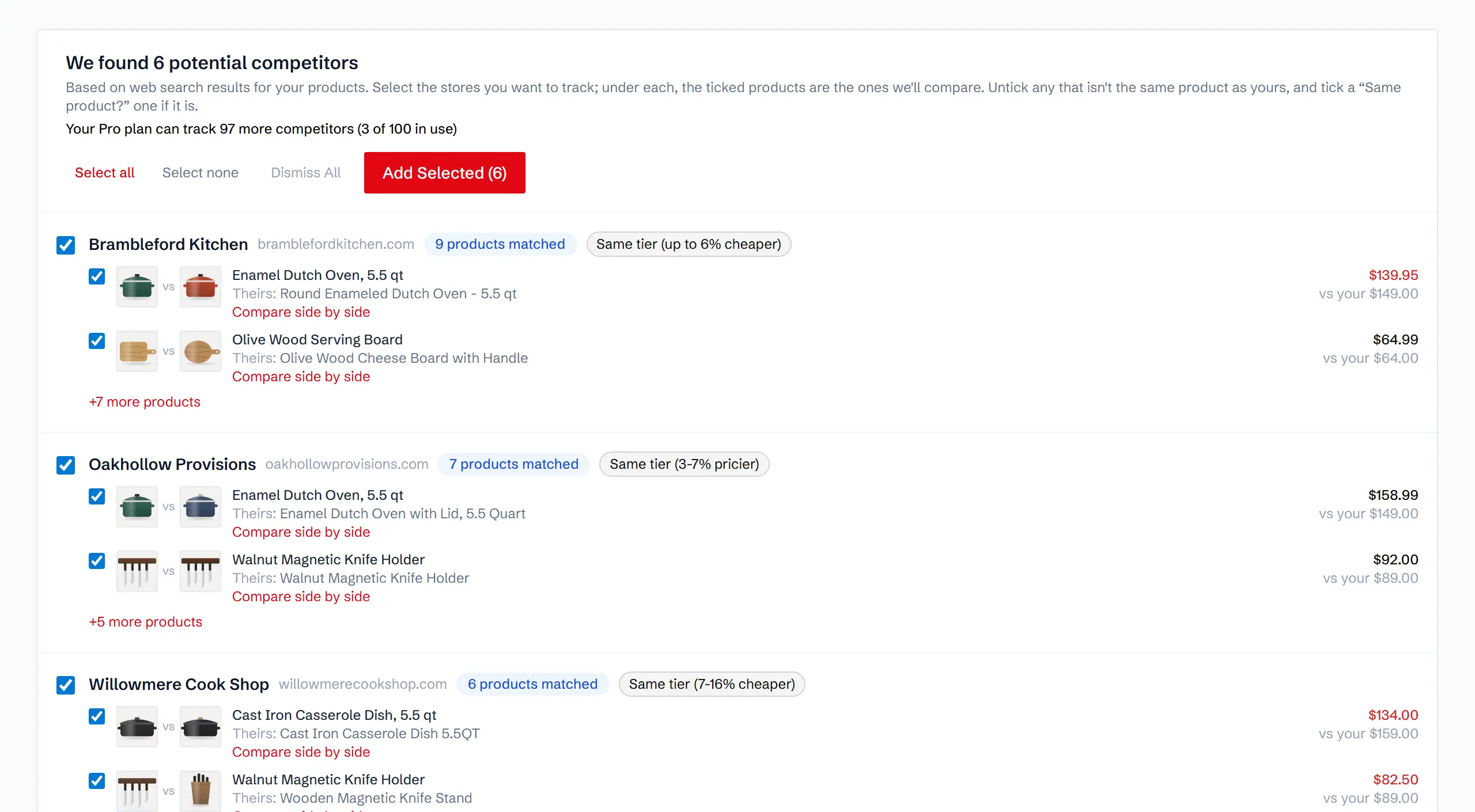
We scan the web for merchants selling similar products in your price range and surface them as suggestions, with how many of your products each one sells and how their prices compare. When the match is clear, we start you off by tracking up to 3 of the closest, and you can remove or swap them.
- 03
Get intel, not noise
Daily price tracking, where you sit against the market, a digest of the meaningful moves - who undercut you, and when you became or stopped being the cheapest of the stores you track - and price recommendations.
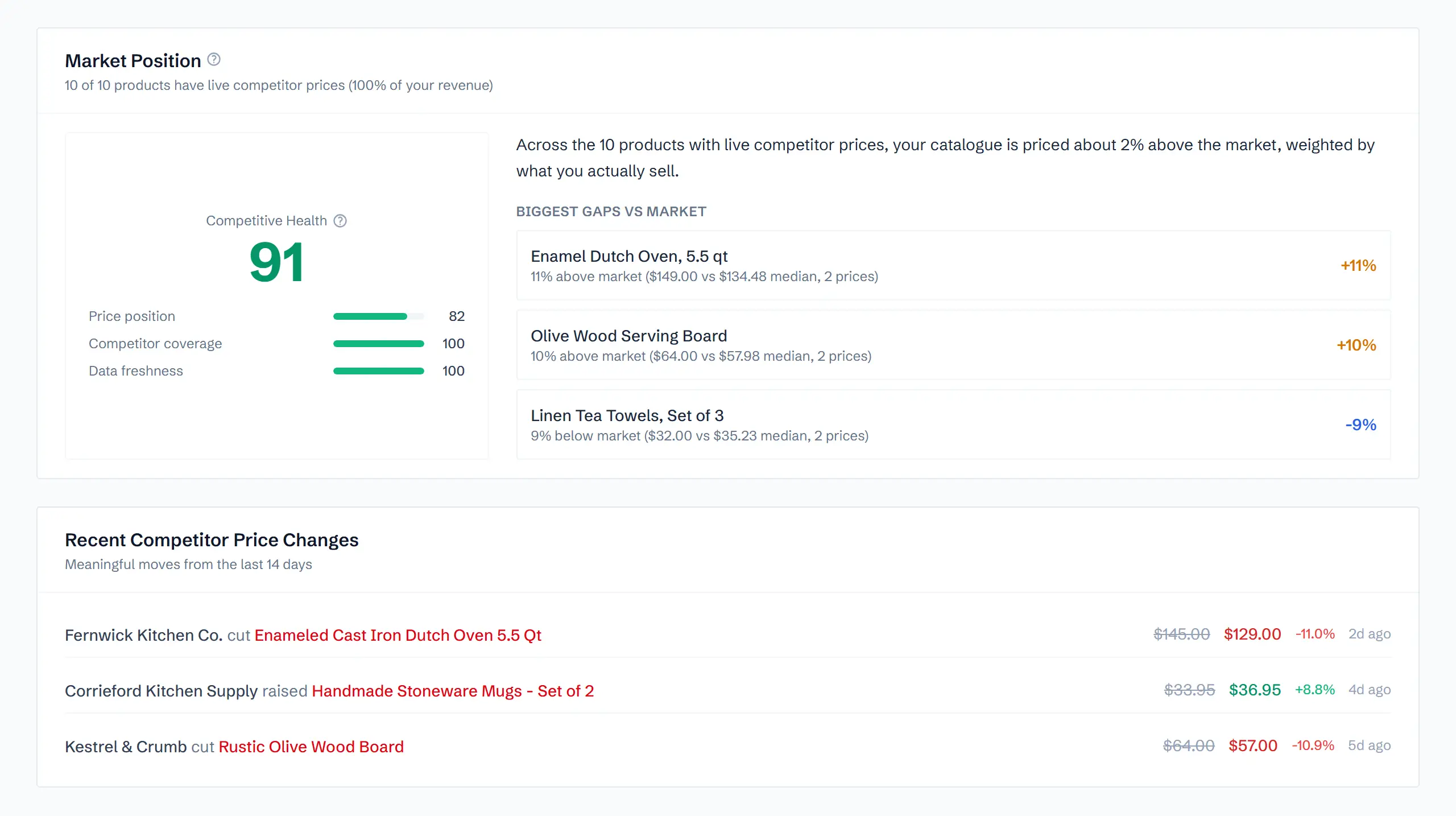
Screenshots show a fictional example store. Names and prices are illustrative.
Competitor intelligence, end to end.
From finding who you're really up against to seeing where your prices stand, and what to sell next.
Automatic competitor discovery
Your catalogue becomes the search input. We find merchants selling similar products at similar prices and rank them by relevance - no URL pasting, no research.
Product research
Find products to sell that can win against the stores already selling them: who sells it, where to price it, how to stand out and where to source it. Pick a niche or let us suggest one, in up to 5 countries.
Daily price tracking
Tracked competitors are re-checked about once a day - via public storefront APIs, product-page monitoring, or web listings. Full price history per item, and 90 days of it downloadable as CSV.
One digest, not inbox spam
Every meaningful price move in one email - who changed what, by how much, and which of your products it touches - plus when you became or stopped being the cheapest, rivals’ sales and stock changes, and the big sale days coming up. Every day.
Sale and stock radar
See when a rival marks a product down from its was-price, runs out, or comes back in stock - with a read on whether a cut looks like a short promo or a lasting change.
Where you rank online
For each product, the other sellers found online with their price and delivery, and where your price sits among them. New sellers are flagged, and we also find stores like yours that sell the same kind of products.
Sale calendar
Black Friday, Click Frenzy and the other big sale days in your market, flagged in your digest before your competitors start cutting.
Price recommendations
The part monitoring tools don’t have: a Bayesian demand model that turns competitor moves into a recommended price - with the expected change in revenue and gross profit attached. Without your own sales history, estimates start from a reference elasticity measured on real retail orders and are labelled as estimates.
Whatever your store runs on
Works with any platform: import by store URL or upload a CSV, and competitor discovery and monitoring run the same whatever you sell on.
Monitoring tools tell you a price changed.PriceSway tells you what it means for you.
A list of price changes is homework. PriceSway compares each rival's price with yours, so instead of “Competitor X dropped 8%” you read “Competitor X is now cheaper than you” or “None of the 5 stores with a current price is cheaper than you on this product now.” Every plan includes price recommendations that never go below your minimum margin.
They say
“Competitor X changed a price.”
We say
“Competitor X is now cheaper than you: $39.00 against your $41.95 (7% below you). Likely a promotion.”
When you act
Every plan recommends a price for products with a unit cost and either a competitor price or enough sales history.
Not sure what to sell next?
Pick a niche, or let us suggest one, and where you sell. Product research checks about a dozen ideas against the stores already selling them online and shows you the best three: a price to sell at, an estimated revenue range, the most you can pay a unit, how to stand out and where to source it. No store needed to start.
Priced by how many products we check every day.
Every plan brings in your store, recommends prices and includes product research, with a 3-day free trial. Your card comes last, and we email you the day before the trial ends.
Starter
For small stores
US$49/mo
- – 250 products checked daily
- – Bring in up to 5,000 products from your store
- – 100 tracked competitors
- – Competitor discovery on 100 products per run
- – Daily digest email
- – Price recommendations
- – 4 product research runs a month
Pro
For growing stores
US$99/mo
- – 500 products checked daily
- – Bring in up to 5,000 products from your store
- – 100 tracked competitors
- – Competitor discovery on 100 products per run
- – Daily digest email
- – Price recommendations
- – 12 product research runs a month
- – Support emails answered first
Scale
For larger catalogues
US$199/mo
- – 1,000 products checked daily
- – Bring in up to 5,000 products from your store
- – 100 tracked competitors
- – Competitor discovery on 100 products per run
- – Daily digest email
- – Price recommendations
- – 30 product research runs a month
- – Support emails answered first
- – Setup help by email
Prices in US dollars.
Competitor prices are re-checked about once a day.
More than 5,000 products, more than 1,000 products checked daily, or several stores? Talk to us.
Frequently asked questions
Want the technical detail? Read how PriceSway works under the hood.
How does PriceSway find my competitors?
Your product catalogue is the search input. For each product, we scan the web for merchants selling similar items at similar price points, then rank the merchants that keep showing up across your catalogue. When the match is clear, we start you off by tracking up to 3 of the closest, and you can remove them or swap them for other suggestions - no keyword research or manual hunting.
Is there a free trial?
Yes. Every plan starts with a 3-day free trial. You add a card as the last step of signing up, nothing is charged for 3 days, and we email you the day before the trial ends so you can cancel from Settings first. Stores we invite can start a Starter trial without one. Price recommendations - a suggested price, with the revenue change we expect, for products with a unit cost and either a competitor price or enough sales history - are on every plan.
How is this different from Prisync or other price trackers?
Most monitoring tools require you to paste in competitor URLs yourself, and they stop at telling you a price changed. PriceSway finds the competitors for you, tells you when one undercuts you and where your prices stand, and recommends prices with the revenue change it expects.
Do I need Shopify to use PriceSway?
No. PriceSway works with any platform: paste your store URL and we read your catalogue directly, or upload a CSV, and competitor discovery and monitoring run the same whatever you sell on.
Can PriceSway help me decide what to sell?
Yes. Product research takes a niche (or "Anything"), up to 5 countries and your price range, checks about a dozen product ideas against the stores already selling them online, and shows the best three: a price to sell at, an estimated revenue range, the most you can pay a unit, how to stand out and where to source it. Every plan includes research runs each month, and you don't need a store to start.
How often are competitor prices refreshed?
About once a day. A scheduled job runs every six hours: product pages we can read directly are re-checked on each run, and competitors found through web search about once a day.
What happens when a competitor changes a price?
The change is recorded with its full history. If it is a meaningful move - at least your threshold (10% by default) and bigger than that competitor's usual day-to-day jitter - your next digest email lists it: who changed what, by how much, and which of your products it affects. The digest goes out daily. The pricing engine factors the new competitive landscape into its recommendations.
Your competitors changed prices this week.Did you notice?
Add your store and see who you're really competing with, with suggested competitors within minutes of importing. No store yet? Start with what to sell.